
If you prefer to watch/listen to the sermon rather than read it, this link will take you directly to that part of the service:
Well, we are back into the routine that we started on back in October, working our way through the Gospel according to Luke. It hasn’t been a very straight line so far. We started by looking at the very first passage, then we skipped over most of the rest of the first two chapters and then picked up with Jesus as a twelve year old in the Temple. We looked at Jesus’ baptism, at Luke’s genealogy, and his account of the temptation of Jesus. We got right up to the point where Jesus was about to start his public ministry and then we backtracked to the passages we had skipped. We went back to look at the announcements of the births of John the Baptist and Jesus, at the accounts of their births and what happened afterwards.
With all of that, we now jump forward again to the very first event of Jesus’ public ministry. The event that, in this gospel, starts it all. I am starting to appreciate how completely Luke foreshadows events. There are places where he does it, obviously and clearly, but I am seeing him doing it in little ways, too. We saw it in the songs of Mary, Zechariah, and Simeon. We see it here. In this very first act of public ministry, we see the totality of Jesus’ ministry in microcosm. We see his powerful claims, his clear testimony, the elation of the people, and their turning on him. We will see this play out on a larger scale throughout the gospel as a whole, but we see it all, in a way, already in this passage.
I found myself waiting and groaning in my soul during Advent in a way that made Advent more literally reflected in my own heart and life than I am used to. If you had asked me why I was turning my attention to the Gospel of Luke, I might say many things, but one thing that I would definitely say is that I was wanting to get back to something that working through a Gospel allows, and that is to spend week after week looking at the actual life and teachings of Jesus. This period of time, represented in the gospels, is the only place we have in all of history where God has stepped into this world as one of us and one with us and we get to experience God in the same kind of way we experience other people. In the Gospels, we don’t have to speculate what God might be like or what God might do or think. We can see it right in front of us. When we were looking at the first passages, Jesus was coming, but he wasn’t here yet. I was waiting and groaning because I kept wanting to look at the life and ministry of Jesus, and we couldn’t get there yet, because we had to cover those early stories. Now we get back into the thick of things.
Let’s set some context to start off with. Jesus had been baptized in the Jordan river. I have to admit that I always thought of this as meaning that Jesus was where John was, which I always imagined as being in the wilderness just outside of Jerusalem. Now, this is a reasonable guess. The other Gospels are at least a little more clear on exactly where this might be. Mark doesn’t say where John is, but he writes that people were coming to him from Judea and around Jerusalem. Does that mean that this is where John is baptizing, or is it just an important region to highlight? Matthew states more clearly that John was “in the wilderness of Judea.” Luke does go so far, in this passage, to say that Jesus had to return to Galilee, which is in the North, which implies that he was baptized outside of Galilee, but it is interesting that Luke doesn’t say precisely where John was baptizing.
In any case, people sometimes forget that, while Jesus was born in Bethlehem, he didn’t grow up there. After the wise men came and left, Jesus’ family fled to Egypt, which is remarkable. Matthew tells us that this fleeing and returning was to fulfill something that was written by the prophet Hosea, when he wrote God saying, “Out of Egypt I have called my son.” This is fascinating in part because Hosea was almost certainly talking about God’s past faithfulness, that God had called Israel, considered God’s son when taken as a whole, out of Egypt in the Exodus. Here we have Jesus kind of summing up all of God’s people in his own person.
After spending however much time in Egypt, Jesus grew up in Nazareth. On the one hand, it is only about seventy miles away from Bethlehem in a straight line. On the other hand, in the ancient world, that was a huge distance. We will drive that in an afternoon without much thought. In Jesus’ day, it would mean a long journey that nobody would have taken without good reason. There are three main regions in Israel at the time. Judea which is in the South, Samaria (which was once also the name of a city in the region) in the middle, and Galilee in the North. You don’t have to know much about Galilee at the time other than it was as far away as you could get from Jerusalem and still be in Israel and that means that the early days of Jesus’ ministry were completely beneath the notice of the powerful people in the capitol.
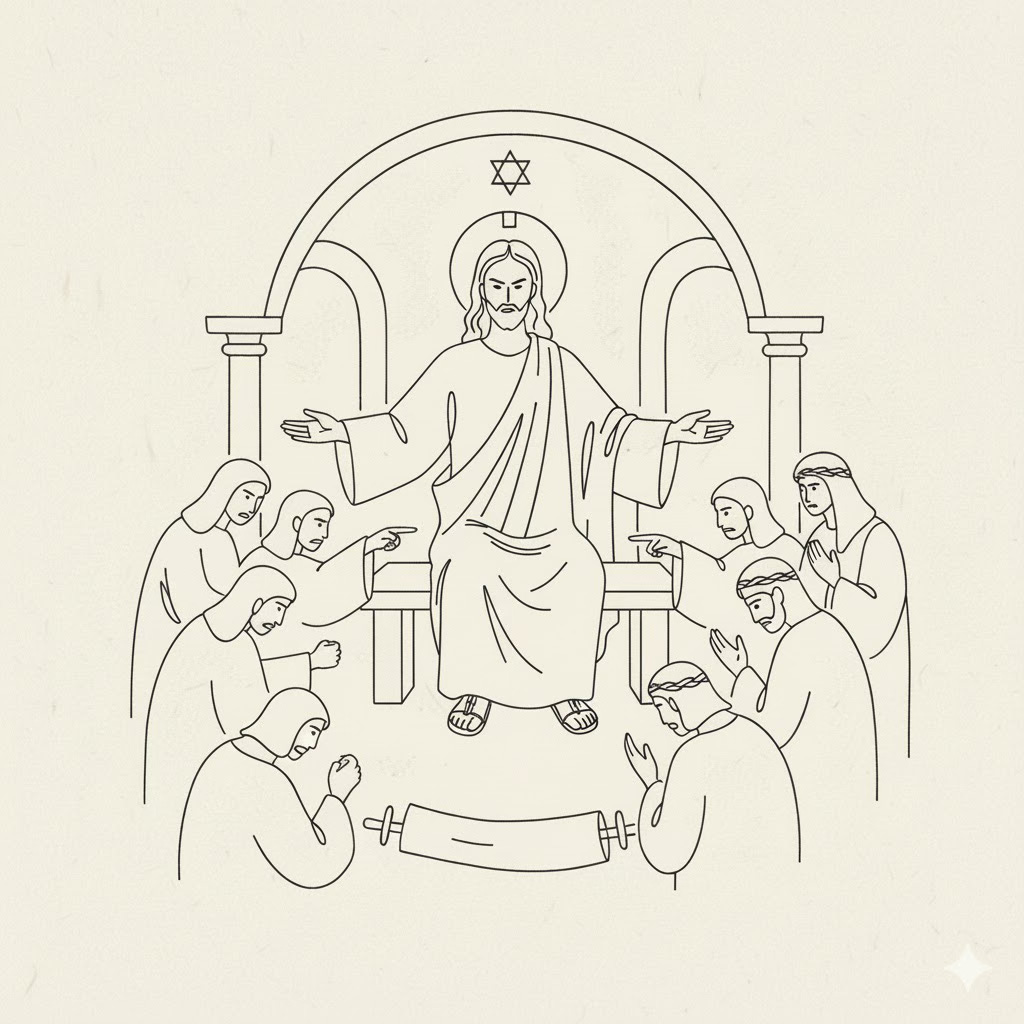
Luke tells us that Jesus has come back and was making a name for himself. I have said that the events of this passage signify the start of Jesus’ public ministry, and this is certainly the first event that we hear about in that public ministry. However, we know that other things have been going on. People’s reactions show that Jesus has been teaching and doing miracles in other places. Why Luke starts here is something I don’t know, but he does, so lets look at things.
We have a different practice in the church today than would have been common in the ancient synagogue. Today, whoever is preaching stands up, does whatever reading needs to be done, and then continues to stand and deliver the sermon. At the time, people would stand for the reading of God’s word and then the preacher would sit and, from a sitting position, give the sermon. This is important because we might think that Jesus was just the scripture reader for that day, read the passage, then sat down as if in one of our pews, and made a comment from among the people. What we see is that the words Jesus says when he sits down are a sermon. The sermon is short, and it is challenging. “Today this scripture has been fulfilled in your hearing.”
I think it is easy for us to miss how bold this sermon is. Imagine I stood up here and I read to you Revelation 22:12-13 and I stood up here, before the sermon, and read, “Look, I am coming soon! My reward is with me, and I will give to each person according to what they have done. I am the Alpha and the Omega, the First and the Last, the Beginning and the End.” Then, we have a prayer like we usually do. Now, I open my eyes, look out to you all and begin my sermon. Imagine if my sermon was nothing more than me saying, “Today, this Scripture has been fulfilled in your hearing.” What I would certainly be saying, and I don’t doubt that you all would hear me saying it, is that I am the fulfillment of that scripture. For me to say that this scripture is fulfilled right now, in your hearing, would be a radical thing for me to say. You would all come to some pretty extreme conclusions. Most likely, you would think that I am out of my mind. If not that, you would think that I am very misguided and incorrect in my interpretation.
We need to keep in mind that Jesus had just read a passage from the prophet Isaiah where it is clear that God is talking about turning the tides of history, of restoring his people to a new way of being and a new era of life in relationship with him. Jesus says that this promise, that was not already fulfilled, has now been fulfilled, right now and in him. Now, we already know who Jesus is, so we don’t get hit that hard by it, but the people at the time didn’t fully understand him yet. How could they?
Now, Jesus had been doing some teaching and miracles in the larger region and so some people took him more seriously than you all would if I did something similar. Some of the people responded with admiration and excitement. However, people pretty quickly changed their tune. We hear people were saying things that are along the same lines as people saying, “Just who does he think he is? Why does he think he gets to talk like this to us.” In other gospel accounts, we hear them say, basically, “We know him and his whole family. He isn’t any better than the rest of us. How dare he do this.”
Jesus responds by criticizing the people from several angles. First, he says, “No doubt you will quote this proverb to me: ‘Physician, heal yourself!’” The idea seems to be that, if he is really a big deal, then why should anyone else come to his rescue when he is in a tough spot. If you can’t even heal yourself, why should we think you can heal other people? Clearly, you aren’t that big a deal after all. Later on, when it becomes politically and socially dangerous to be a follower of Jesus, that same comment sends the message, “Why should we put our lives on the line for you, when you seem to be on your way out?” It is a sign that they don’t really believe he is who he seems to be.
Another thing Jesus says is that the people will ask him to do the same miracles in Nazareth, in his hometown, that he had done in the other cities in the area. Again, on the one hand, this might seem like they just want to be included in the mighty works of God. On the other hand, there seems to be a certain amount of these people in Nazareth thinking that they are better than the other places. If that is so, then Jesus should definitely do miracles here. In fact, he should do even more miracles, since these are the best people. After all, they were the people who were around when he was growing up, surely he owes them something.
Jesus then says something that is probably still basically true. He says that “no prophet is welcome in his hometown.” I have not been able to test this personally because I don’t really have a hometown. I moved seven times before I graduated from high school. There is literally nobody, outside my family, who knew me throughout the whole process of me growing up. I have preached in the pulpit of the church that sent me into ministry, but that was really only once since I started as a pastor, it was even before I was ordained, and the people there only knew me for a short period of time. I really only spent my senior year of high school involved there full-time.
Here is a story I heard not that long ago. It is about a pastor who is retired and he was sharing with me an experience a long time ago in another state altogether. They were having a hard time getting the leadership that they needed for their youth ministry. It was growing but it needed a lot of support from the people. He had tried to get people involved in a bunch of different ways but it hadn’t been successful. He was lamenting it to an older colleague and that other pastor asked if he could come and preach some Sunday, which they arranged.
I don’t know if this happened in the church service or if there was another event after the fact. This other pastor laid out what they needed to do in order to have a thriving youth ministry at the church. He talked about having to raise their budget, and therefore giving, by many thousands of dollars and he listed off all of the things that needed to be done and paid for. At some point, one of the congregation members stood up and said, “Wait a minute. Why do we have to pay all that money to make all of that happen. Couldn’t we in the congregation do that?” Before long, they had people almost fighting over who could volunteer to help.
Of course, this guest hadn’t said anything new that this friend of mine hadn’t said. The advantage was that he wasn’t from there. There is a saying that an expert is anyone who had to travel over 50 miles to get there. It is so easy to imagine that we already have everyone we know sized up, and we will never be surprised by them. If, as can happen in towns like this, you see someone grow up from childhood into adulthood, you have seen all kinds of things. You have seen their strengths and weaknesses. You have observed their mistakes and their successes. This can happen in any sized town, but it seems more common in small towns. Some people don’t ever want to leave, some can’t wait to get out but then come back. There are some people who either want to get away, or else don’t ever want to come back because they feel everyone has already decided who they are and they don’t have a chance to show them that they have grown up.
That may not always be true, but there does seem to be this sense that the people that we know may be wonderful people, they may be hard workers, they may be effective leaders in different ways, but if someone was really talented or effective, they would be somewhere else. Cities look down at small towns because they believe that, and at least some small towns believe it about themselves because they have all too often seen people grow up and leave. Being told that from outside and inside the community can get people thinking that nobody around here has anything to say. If someone is going to change the world, they need to be from somewhere else.
Before I comment on Jesus’ final words of this passage, I want to make one more comment about this kind of attitude. You may never feel it, or you may only feel it sometimes, or maybe you feel it a lot. Here is the truth of the gospel for us. God wants to meet the needs of this community with this community, and I am not only talking about Marcus. Do you want to know why these particular people are here at this particular time? It is because God has something in mind regarding them. If there is a need, God has given these people, this community what it needs, although what it needs is always going to involve people relying on God’s strength. If you see a need and your heart breaks, it is almost certain that God is calling you to be part of the solution. If you feel like there is something that needs to be done, don’t sit around and wait for someone else to do it, get up and be part of the solution. Nobody more qualified than us is coming. In fact, there really isn’t anyone more qualified. We are the ones who are here and that, plus the grace of God, qualifies us to meet the need.
The last thing Jesus does, and this really ticked off the people, is draw attention to some famous stories in the Old Testament. He points out that there were many widows in Israel during the time and ministry of Elijah. However, when Elijah was in need, when the drought that God had brought about as predicted by Elijah got to be so severe that the river he had lived by dried up, God sent him to a specific woman’s house. While he was there, he worked miracles that preserved the lives of her and her son. Later, he raised her son from the dead. The point is that this particular widow was not from Israel, not from the people who had historically belonged to God, but a foreigner, a woman from a nation that rejected God.
He also reminds the people that, during the time of Elijah’s protege, Elisha, there were many lepers in Israel. We read a story of Elisha healing a particular leper, but he wasn’t from Israel, he was from Syria. Not only that, he had the kind of job where he had to take a ruler into the temple of a pagan God and support him as he bowed down to worship it. Theoretically, Elisha could have healed any leper, so why not heal an Israelite one and not some foreigner who is clearly closer to worshipping an idol than God?
On the one hand, we could argue that these miracles could have happened to anyone, that it just happened that God was showing grace to foreigners as he often did. The way Jesus reminds the people and what he has just been talking about makes it seem as though the truth of the matter is that God wanted to perform miracles and healings in Israel but he didn’t find people who would respond with faith. To find people who would receive him, he had to look outside of his own nation.
Whether that was fully Jesus’ intent or not, that is certainly how the people understood him. Earlier, they were at least a bit interested in what Jesus had to say. Now they were mad. This is what we read: “And all the people in the synagogue were filled with rage as they heard these things; and they got up and drove him out of the city, and brought him to the crest of the hill on which their city had been built, so that they could throw him down from the cliff.”
I imagine that, at least once in your life, you have heard a sermon where you didn’t entirely agree with what the preacher said. I would be surprised if that has never happened to you. You might even have heard a sermon that got you worked up. Perhaps you have heard a sermon that made you angry. But have you ever heard a sermon that got the whole congregation so angry that you all tried to murder the preacher? That is what was going on that Saturday in Nazareth. In the course of one synagogue session, they went from being slightly curious, to fairly proud of this leader their town had produced, to being so angry that they try to commit murder.
We human beings like things the way we like them. As a general rule, we tend to think that someone who tells us that God likes the same things that we like, likes the same people that we like, and generally wants us to be healthy, wealthy, and comfortable is a great messenger. What we find, over and over again throughout the Bible and especially in Jesus, is that God’s message nearly always pinches us, prods us, and gets a reaction out of us. Sometimes that reaction is positive and we open ourselves to God working in us to transform us. Sometimes, we try to murder the Son of God. I think that we actually have a version of this choice before us more often than we may think.
Every day, you have a choice about what will be your highest priority. Will God’s will be the most important thing in your life, or will you say you have other things you need to do first? The reason that Jesus tells us in the sermon on the mount to seek first the kingdom of God and his righteousness is because, if we don’t seek it first, we tend to seek it second, well, or maybe third. Ok, we often don’t even seek it third, but so long as we seek it eventually, its ok, right? Well, if we are honest, there are probably days when we kind of forget about it altogether because there was so much other important stuff to do. If God only paid as much attention to you as you do to God, what would that be like?
Jesus is in our midst. For the love of God, follow him where he leads, because he will always lead us to where we need to be. Let’s pray.