
If you would prefer to watch/listen to the sermon rather than read it, this link will take you directly to that part of the worship service:
Last week, we were introduced to John the Baptist, the first genuine prophet in Israel for four hundred years. He dressed oddly and ate strange foods and so doesn’t always make a lot of sense to us modern, twenty-first century Americans, but he is absolutely the kind of person that people at the time would have expected. We considered his approach which is, again, alienating and off-putting for us today, where he used the unique strategy of criticizing the people who were coming to him. He didn’t do what so many people, even churches and church leaders, have done, and sit aside in his own comfortable building and rail against the sinners “out there,” he took aim at the very people who saw themselves as responding the “right way” to the call of God through a prophet.
In particular, we focused in on his attack, where he called the people offspring of vipers and suggested that their identity as the “right kind of people,” was totally irrelevant because God could make those kinds of people out of the stones on the ground. The idea was that God doesn’t want a group of people who all belong to the right groups and not the wrong groups, God wants people who live lives that bear the fruit of repentance, people who not only say they are going to follow God, but whose lives actually show they are doing it.
The first part of this preaching, which we considered last week, almost made it seem like nobody who came to hear from John was actually prepared to do what they needed to do. It was such a ferocious criticism that it would be easy to imagine that basically everyone heard him and said, “Well, forget this. I don’t need to put up with this kind of treatment.” What we read this week is that many of the people stayed.
Who knows why they stayed? They may have stayed because they felt like his criticism was valid and they genuinely wanted to do what they needed to do in order to truly turn to God. They might have stayed because they wanted to hear what kind of nonsense this madman thought was expected so they could ridicule him more. They might even, if they were particularly confident in themselves, have stayed because they thought he would lay out expectations that they were already meeting so they could gloat over the others.
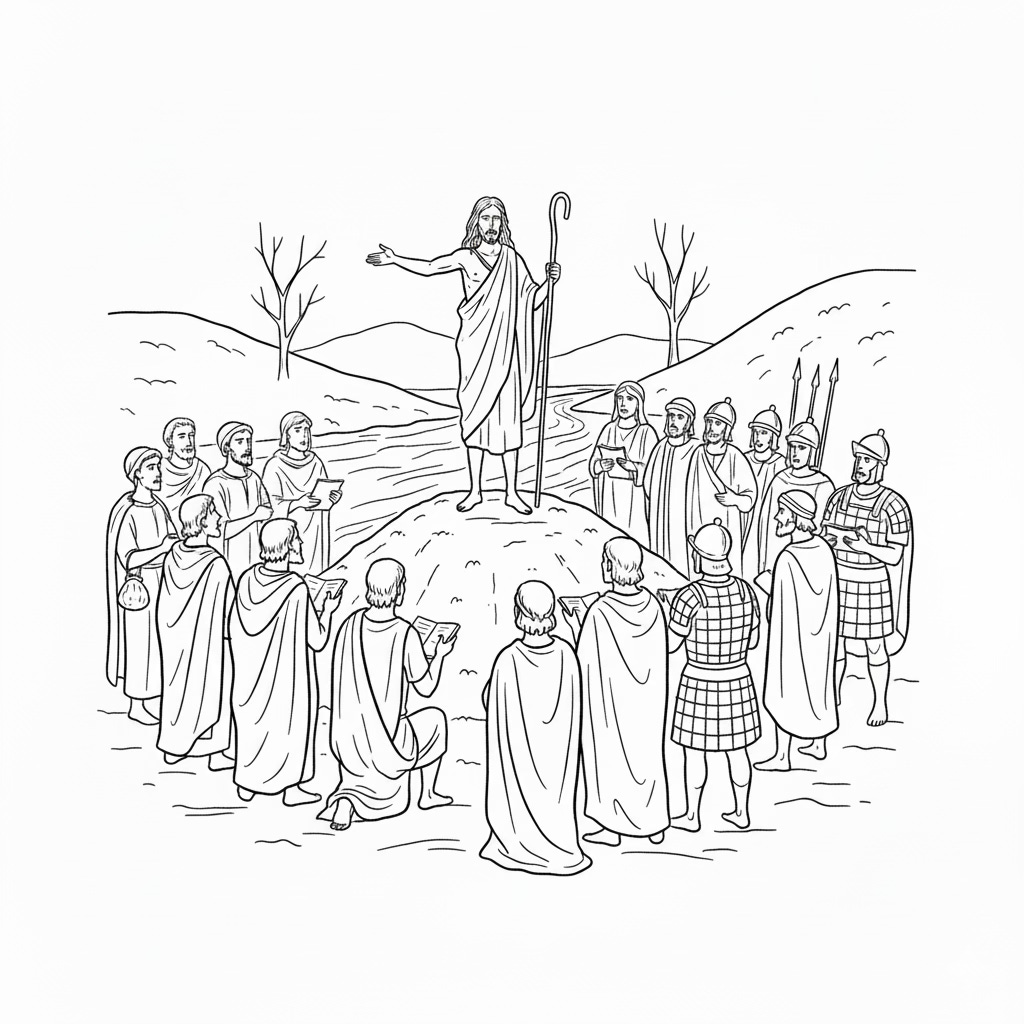
Regardless, there were indeed people who stayed, for whatever reason, and we read that they asked “What are we to do?” Again, this could be a skeptical question, as if they were saying, “Well, John, what do you expect us to do,” as if they thought they were already doing everything. There is a real chance, though, that people were coming to John because they knew that they needed guidance. If clinging to their heritage as Israelites was not sufficient, if standing against their Roman occupiers didn’t satisfy God, if doing the kinds of things that occurred to them to do as a sign of repentance was not deep enough, then they clearly need a word from outside of them, they need the voice of the prophet to tell them what they either can’t tell themselves, or else that they don’t want to tell themselves.
There are two sides of John’s response to the people that are worth considering. We get three groups of people described as asking, essentially, the same question, “What are we to do?” We read about “the crowds” asking it, “tax collectors” asking it, and “soldiers” asking it. I don’t know for sure why Luke highlights these three groups, but I will give at least one reasonable interpretation. The crowds are the ordinary folks, the people who were mainstream Israelites, doing their best. The tax collectors are the people who were likely Israelite by ethnicity but had become comfortable working with the Romans and were often seen as traitors to their fellow countrymen. The soldiers would almost certainly not have been Israelites but foreigners serving in the Roman army, present as an occupying force. These particular soldiers were probably at least interested in the God of Israel but would not have grown up in the Israelite culture or religion. It is meant to show us that the call of God through John is already anticipating the worldwide mission that we see Jesus engaged in.
One of the sides of this teaching is that John tailors his teaching to each group who asks him. The question, “What are we to do” has somewhat different answers depending on who is asking it. This is part of why preaching can be a bit difficult. If you ask me what God wants you to do, part of the answer is always going to have to be “Here are some general principles, but there is no way to know for sure what God wants you to do if you don’t pray, read the Bible, and listen for his guidance.” I can put forward some general teaching and advice, I can point out ways that we sometimes try to fool ourselves or get ourselves off the hook of doing the real work of faith, but I can’t tell each person what God would have them do. No preacher can do that.
That being said, we can see that the response that John makes to each group is definitely going to be a challenge to each group. No group gets what we could call an “easy” set of instructions. We can imagine that each group would leave that day with a sense that it is not possible to follow John’s instructions by just tacking on one extra thing every so often. They were all going to have to make real and difficult changes.
What that means for us is that, if we come to the prophets of God for instruction, we need to expect that they are going to challenge us. None of these groups came to John, asking him what to do, and then heard him say, “You know what? You are already doing as much or more than God expects of you. Just keep up the good work. In fact, you can probably relax a bit. Don’t take everything so seriously. Make sure you live life to the fullest.” That is the kind of thing that I think a lot of us would like to hear but we don’t read that anyone got that kind of message, or really anything like it.
This means that, when we really pray and we really open ourselves up to God for his guidance, there is a really good chance that he is going to tell us to do something that we don’t really want to do, something that we may find inconvenient. In my own life, one of the ways I have been more confident that what I am feeling like I need to do genuinely comes from God is when it is something that I don’t really want to do or will make my life inconvenient. Living the way that God calls us to live is always going to pinch us, at least some times.
In fact, one of my biggest worries as a leader in the church is that it is so tempting to collapse what it means to be a Christian into nothing more than what it means to be a generally “nice” person, who lives basically the way everyone else lives. There are moments when people seem like even to act like being a Christian ought to be the kind of thing that gets us beneficial treatment, as if the world owes me something because I am a Christian or that people shouldn’t expect as much from me since we are on the “same team.”
An overarching thing to remember is that it is impossible to follow God without that sometimes challenging you. If I say that I am following another person, there are going to be times when what it means to follow them is going to mean having to not do what I would otherwise do. If following the authority in my life never requires me to do anything other than what I wanted to do in the first place, it means I am not really following that authority, I am only following myself. The same holds for following God. If you never hear God tell you to do something you don’t want to do or to stop doing something you want to keep doing, it is likely, probably to the point of certainty, that you aren’t listening to God closely enough.
This all brings us to the point where we need to acknowledge one aspect of John’s instructions that may actually make this passage tougher, in the end, than the last one. We looked at the passage last week where John described the people as the offspring of vipers. On the one hand, that sounds like it is as tough as it can get. Basically anything else that he could possibly say has got to sting less than that, right?
That may not necessarily be the case, because, after all, while being called names can hurt and nobody really should do that, I know that when someone has resorted to calling me names, it means that they don’t really have anything of substance to say to me. I can not like it when people call me names but I can mostly just brush them off. To be clear, I don’t think that John was calling people names. I think he was making a real and pointed criticism of the people. What I am saying is that it is possible that people might not have taken those words seriously if they interpreted him as exaggerating for rhetorical effect.
The reason that John’s instructions might make this even more uncomfortable is that, while his advice is somewhat different to each group, it also has a common theme. When the crowds asked what they should do, his answer was “The one who has two tunics is to share with the one who has none; and the one who has food is to do likewise.” His response to the tax collectors was, “Collect no more than what you have been ordered to.” His response to the soldiers was, “Do not extort money from anyone, nor harass anyone, and be content with your wages.”
Every single one of his responses is economic in nature. The ones who were arguably the furthest away from God got the least invasive instructions. Soldiers were told not to extort people, not to harass people, and to be content with their wages. They are called to do their jobs and not get greedy. They shouldn’t use their power to make the lives of other people worse. They have a job, it is probably a job that pays fairly well, or certainly well enough. They don’t need to become bullies. That is the bear minimum. Stop being antagonistic to other people. Be content.
The tax collectors are given similar instructions, “Collect no more than what you have been ordered to.” That may seem like an obvious course of action, but it was widely understood that the tax collectors were collecting more than they were ordered to and then keeping the extra. It is one of several reasons why the mainstream of the Jewish people distrusted and even hated the tax collectors and why it will be so radical that Jesus ministers to and with them later on.
We can stand on the sidelines and think that this is a perfectly reasonable thing for John to say and that it would be totally unreasonable thing if the tax collectors and soldiers were to complain about it. The thing is, there would be huge social pressures against following John’s instructions. For one tax collector to become totally honest, for one soldier to stop exerting their power over the people, would get the rest of the group fighting back. I imagine that the situation would not be unlike the scenes in movies where a corrupt drug squad in a police force gets nervous and angry when someone comes in to try to clean things up and all they do is refuse to take part in the scam. Following John’s teachings will cost these people something. If we are people who are not caught up in corruption, or if we are caught up in a different kind of corruption, or if we are caught up in the same kind of corruption, but in a way that is less obvious, we can say we should just do the right thing, but doing the right thing in a corrupt environment is a radical act and will be met with a challenge.
The crowds get the toughest teaching. They aren’t in positions where they are scamming people, they aren’t in positions where they are extorting or harassing others. They are already doing what John has told the tax collectors and soldiers to do. They, however, are told that, if they have two coats, one of them belongs, in fact, to someone who doesn’t even have one, and they need to get it to them. If someone has more food than they need to survive, the extra food actually belongs to someone else and they need to share it with them.
Again, there is differentiation even within this similarity of teaching. If we had a small farmer, just growing enough for his family and a bit extra, and he came up to John, it is pretty unlikely that he would get the same instruction that John gave to the soldiers. After all, he can’t be “content with his wages” because he doesn’t get wages in the same way, unless you count the produce and money earned from the work over the course of the year. It is also unlikely that this imaginary farmer can harass people in the same ways the soldiers in the occupying force could harass the people. The farmer, in this case, is much more likely to be the one harassed.
It is clear that, if we were to extend this teaching from John, we are left with the fact that not everyone gets exactly the same set of directions, and yet they have the two things in common: first, they are all aimed at the kinds of temptations and sins that are most likely to impact each group of people and second, they are all economic in nature. What economic sins are the soldiers most likely to commit? Complaining that they don’t have enough, even when they have more than most other folks at the time and harassing others, either just because they are abusing their power or, just as likely, they are extorting the people. What economic sins are the tax collectors most likely to commit? Telling people they owe more than they actually do and pocketing the rest. What are the economic sins that the mainstream of folks are most likely to commit? Keeping far more than they need when there are others who are going without.
So, I don’t know what John’s words would be for you, but I bet they would pinch. The soldiers saw harassing people as one of the perks of their job. They could push their way into any circumstance and be the most powerful person there. They could physically shove people out of the way and there would be nothing anyone could do about it. To stop doing that would make them an outcast among their peers. To advocate for kindness or even just to model it without advocating for it would almost certainly annoy their fellow soldiers because their behavior would highlight the cruelty of the others.
The tax collectors almost certainly sought out that job in the first place because it was highly profitable, above and beyond what the usual pay was, because they could skim a bit off the top. If you could get, essentially, an extra $5 out of every man, woman, and child, that adds up. In Marcus alone, it would be over $5,000 extra, more if you are collecting for Remsen, too. A little bit goes a long way.
The general population would almost certainly say they are preparing for the future, they are building up a reserve against the unexpected. This is the most challenging for most of us, I think. After all, as we can all see, in our lives or the lives of others, the unexpected does happen. It feels reasonable to take some precautions against the unexpected. It is complicated because I think that we can all agree that there is a point where taking reasonable precautions against the unexpected can turn into hoarding and miserliness. If someone said that they had to hold on to ten million dollars just because they don’t know if they might have an unexpected expense pop up, we might reasonably wonder if they need quite that big of a cushion when they could use that money for other things. If someone, because they have extra money, decides they don’t just need a house that is twice as much as they realistically need, but one that is four times as much as they really need, it isn’t crazy for people on the outside to wonder why that is the best choice. We may not always know where that line is for any particular person, but we usually believe there is a line.
To be clear, I am not trying to micromanage anyone else’s decisions. My point is that I think that it is easy for all of us to look to other people and question how their economic surplus is used. We don’t tend to like it when people do it to us. We might wonder why anyone thinks they have a right to even have an opinion on what we do, and even less why people should feel they have a right to voice it. If we even hear it in the first place, we can brush it off.
The thing is, God is not so easily brushed off. I want to remind everyone once again that one of my least favorite topics to talk about in the pulpit is money. I could imagine simply avoiding every passage that would require me to talk about it, but that would require me to avoid rather a lot of the Bible, because it is a frequent topic. There are so many pitfalls when talking about money in a church. It is so easy for preachers to fall into one error or the other. I could get it wrong by trying to so emphasize giving that it reinforces the stereotype that churches only want people’s money, which is not true. I could also get it wrong by making it seem like God cares about how you treat others and how you relate to God but doesn’t care about how you spend your money, but that is also not true. Our spending habits are probably the most revealing things about who we are.
John finishes his words in this story by saying that he is not the coming Messiah. Someone is coming who is going to be far more than him. Basically, he is saying, “If you find me challenging, you ain’t seen nothin’ yet.” We also read about John giving a word to a powerful person that they did not want to hear and it resulted in his being arrested. We will read later on that it ultimately results in his being executed.
People didn’t always like what John had to say. Some may have just walked away and ignored him. Some, though, took so much offense that they retaliated against him. We don’t know for sure who listened to John’s teaching, but Herod the Tetrarch definitely didn’t. We don’t know about the other people. We can’t know about them. The only person we will know for sure is listening or not to John, to Jesus, to any message from God, is ourselves. Make sure, as you put yourself in a position to hear the word of God, you don’t just hear it and walk away, but build it into your life. That is the only way discipleship works.