
If you prefer to watch/listen to the sermon instead of read it, this link will take you directly to the reading of the scripture in the service:
Today, we jump backwards from where we were the past few weeks and look at the first passage of narrative in the Gospel of Luke. We had looked at Luke’s introductory remarks and then jumped forward to the ministry of John the Baptist. Now, we are back to the beginning so that we can consider the story of the gospel leading up to Christmas. By doing this, we will end up with the narrative of the birth of Jesus right at Christmas Eve.
We just recently celebrated this congregation’s 150th anniversary and so, understandably, the idea of history and heritage has been on my mind. We have had reason to reflect on the fact that none of us came to faith totally out of nowhere. Even if we grew up knowing nothing but the love of God for us in Christ and so never had a time when we felt that we were estranged from God, it still didn’t just happen. It is because people, in more or less broken obedience, shared that love with us. If we are people of faith, it is because there were people who embodied the gospel in our lives.
That is hugely important. We sometimes think of faith as mainly something that we know but the New Testament consistently depicts it as something that we live. There is stuff to know in our brains, to be sure, but it all has to be embodied and lived out in our hearts, our hands, and our feet or else it isn’t the gospel in the full sense of the word. We can have whatever preferences we may have, but it seems as though the way that God prefers to work, and indeed God works this way nearly 100% of the time, is to work in and through his people.
We might think that it would be best for Jesus to just travel around the world, doing miracles and proclaiming himself as the kingdom of God come to earth, but that isn’t what God does. We might think that it is a bad idea for God to take ordinary, broken people, and send them out into the world to be his messengers. We are very aware of the flaws of that plan, all the things that can go wrong. We are deeply concerned with our own shortcomings and, all too often, decide that God must have made a mistake when he called us into ministry in the world and so, since it is so clear to us that God made a mistake, we will correct it by simply not going and not doing what he has told us to do.
The problem, of course, with that way of thinking is that we clearly do not get to tell God he is wrong. We do not get to say that he made a mistake in calling us. We do not get to decide that our being uncomfortable should count for more than his call and command. We are called to not just know the truth but to live the truth and that always happens in real life and history.
All of this matters as we look at this passage. Jesus is not in this passage except way in the background, and we can only see that because we know where this story is going. Zechariah is told that his son, to be named John, will “go as a forerunner before him (meaning God) in the spirit and power of Elijah,” a reference to the last verses in the Old Testament. Aside from that hint, Jesus isn’t anywhere to be found in this passage. It is enough to make us wonder why Luke felt it was important to tell us about it. Maybe it is important that we know who John the Baptist is and know something about his ministry, but who cares about the story of his parents being told he was on the way?
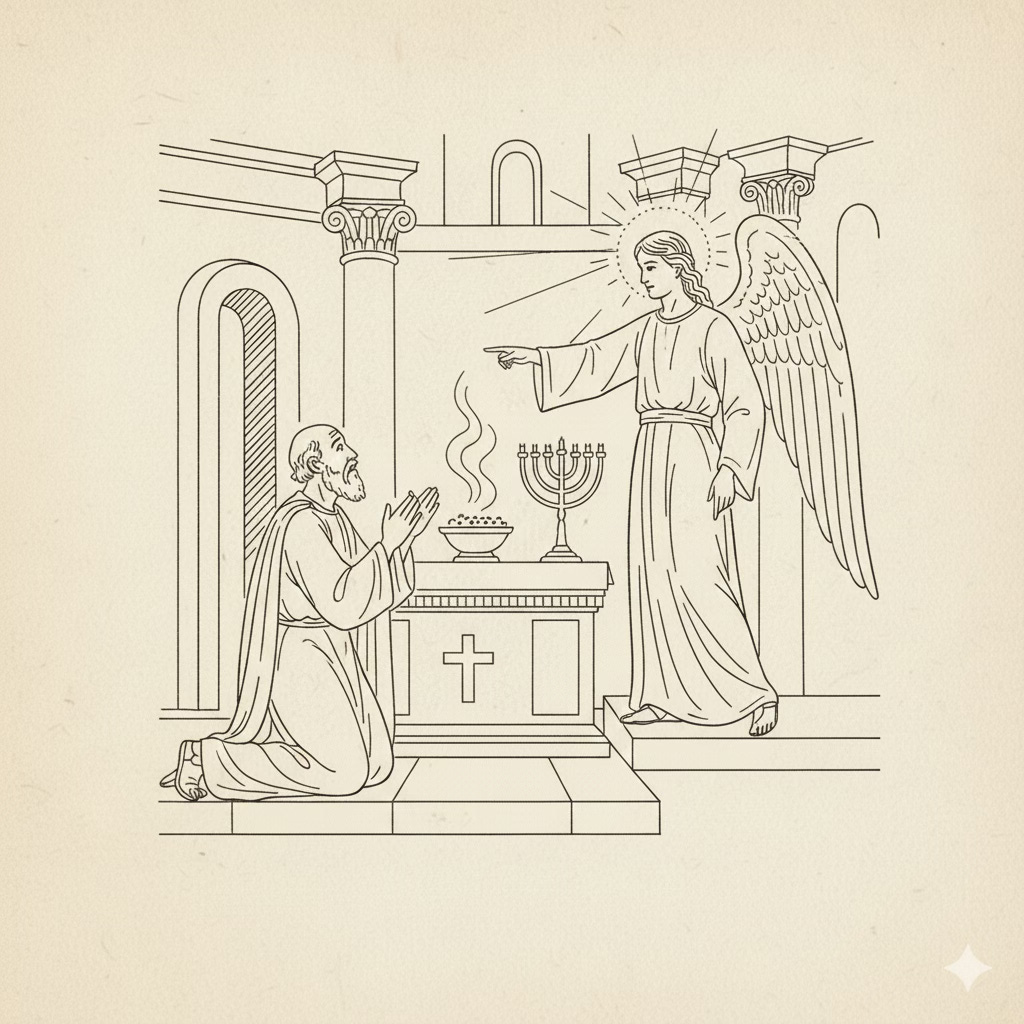
Part of it is because John is going to be a miracle baby. From a merely human point of view, he should not be on the way. His parents are very old, have never been able to have children, and all of age and biology say that he cannot come. Even if he were to come, all the other stuff makes it clear that it would be what we call today a “high risk pregnancy.” Part of why this announcement is important, though, is because the Old Testament has told us about more than one miracle baby over the years.
First, we have Isaac, also born to parents in their old age when all of biology told them it would be impossible. Isaac’s birth was so impossible from a natural perspective that the whole Biblical witness treats his birth, and therefore the whole heritage coming from him, as being the product of God’s promise and miracle, and not Abraham’s work or ambition.
We don’t get, in the Old Testament, miracle births in the same way that we will have Jesus. We do not read of any virgins giving birth. What we do get is people who have been so barren for so long that the only way to interpret them having a child is a miracle at the hands of God. Rachel’s child Joseph fits that description. Later on, Samson is born under similar circumstances. Here, for the first time, this baby is not just a miracle in the sense that he will enable and further the heritage in general, he is born to be a kind of savior for the people. Samson is a very broken savior, but he does indeed deliver the people. The next miracle baby in the Old Testament, Samuel, takes things even further. Samuel becomes the most significant prophet in Israel’s history after Moses. He becomes a great leader of the people. He guides them, reluctantly, from the era of the judges to the era of the kings.
This string of miracle babies almost makes you think that this kind of thing happened all the time. It didn’t. Yes, those are four examples, enough to develop a theme and a pattern, but four in the whole history of God’s people up until John the Baptist isn’t exactly “all the time.” It happened enough for it to be clear that God does do this sometimes, but not so often for it to lose its significance. There is no way that Zechariah and his wife, Elizabeth, once they got over their disbelief of the message of the angel, would not have seen their child as being in the heritage of these previous leaders, especially Samson and Samuel, because they were also designated as what are called “Nazirites” from birth. Nazirites were people dedicated, for their whole life or for a period of time, to the Lord in some special way. The signs of a Nazirite were that they did not approach dead bodies, they did not drink alcohol at all, to the point that they were not even to eat grapes and raisins, and they had long hair because they never cut it.
Zechariah’s first response is one of disbelief. He cannot understand how this thing that the angel says is going to happen. It has been the dominant approach throughout the history of the church to stand in judgment over Zechariah. After all, it is clear that he is wrong. Knowing what we know, he absolutely should have believed the angel. It is hard for us to imagine seeing an angel, face to face, and not trusting that they are telling us the truth.
But here’s the thing. Has that ever happened to you? Have you ever been face to face with an angel? We read, at the end of Matthew’s gospel, that there were people who were in the presence of the resurrected Jesus and still had doubts about him. Clearly, we have a huge capacity to doubt in the face of the work of God.
Let me put it this way. Have you ever had a particularly strange experience, something way outside your usual experiences? If you have had one of those, especially if it happened once and then never again, have you not ever doubted, after the fact, whether it really happened, or that you might be mixing up the details? Unexpected and unexplained experiences put us in a tough spot. What is more likely, that this thing that is totally unrelated to anything I have ever experienced before in my life and it never happened again is true, or I dreamed it, or I misunderstood something? It is understandable that Zechariah would have some doubts. We probably would, too.
There is a sense in which the angel, by making it so that Zechariah could not speak until everything came to pass, is a punishment. I know that I tend to read that pronouncement with a punishment tone. More and more, though, I am not so sure. I am starting to think that this was the greatest blessing he could ever have given him. Think about it. If Zechariah had the experience that he had but then walked out of the Holy of Holies just the same way as he went in, it would be really easy to imagine that he dreamed the whole thing.
When I was a kid, I would sometimes wake up the day after something really good had happened and I would have this worry that maybe I had dreamed it, and it didn’t really happen. I remember in particular the morning after I got my first electric guitar. I was so worried that I had just dreamed it that, once I woke up, I ran right to it and got it out of its case so I could play it. I needed that physical reminder that it actually happened. Eventually, once I could wake up a few more days with it still being true, I stopped doubting it, but that first morning made me nervous.
That is part of why, for all the inconvenience of not being able to speak, I bet that Zechariah was glad that it happened. If he woke up the next morning and wondered whether he really encountered an angel of the Lord, he could be reminded of the truth of that experience the moment he tried to speak. Every time he had to pull out a tablet to write what he wanted to say, it was a reminder that he could not speak and I bet he couldn’t be reminded of the fact that he could not speak without remembering the promise that came at the same time.
Now, let’s be real that it would also have been a big pain. Once Elizabeth became pregnant and once it became clear that she was likely to carry the baby to term, he might have thought to himself, “Ok, God, I got the message. You are trustworthy. I was wrong to doubt you. It is now abundantly clear that you are following through on your promise. Can I speak again?” In those first days, the lack of speech would remind him to look for God’s promise, but once it became clear that God was keeping his promise, there would have been months where he had to wait in silence for things to come to pass.
So, here is a word of comfort. We read about God being exasperated with his people. Sometimes, it is as if God is rolling his divine eyes at our response, annoyed that we still don’t get it, even after he has proved himself over and over again. And yet, it seems like, so long as our response is not driven by rebellion, by a desire to get out from under God’s rule, there is grace, there is comfort, there is blessing, even if the blessing is also a bit of a pain, like it was in Zechariah’s case.
I have been more and more convinced that our biographies can explain a lot about what we do. I don’t mean to say that we are trapped in the past, but that our formative experiences do indeed shape how we think and behave in the world. I have met people who grew up in a very loose environment. They had little to no spiritual formation, or they had some but it was only occasional and not reinforced at home. They lived a wild youth or young adulthood and went a little nuts. When they come to faith and encounter God through Christ, they look back and see all the destruction they brought into their lives and they become determined to never go back to it. They might become fairly strict in their spiritual disciplines because they have seen how far they can slide if they don’t. As a result, they are likely to think that the problem most often faced, in the church or in the world, is that people aren’t taking their devotion seriously enough. To be clear, I am not necessarily criticizing this. I am just saying that the people I have met who are the most strict about what it means to be a Christian tend to have a reason for it somewhere in their past.
On the other side, there are people who grew up in the church and it was super strict. Precisely what was and was not allowed was clearly defined and woe betide the person who did the wrong thing, or said the wrong thing, or wore the wrong thing, either to church or outside of it. That person might very well have had a time of running away from God when they were no longer in that environment, going out to try all of the things they were always told not to do when they were growing up. If they come back to the faith, they are likely to think that the biggest danger people have, at least in the church, is taking things so seriously they end up setting up rules that have more to do with our culture of Christianity rather than Christianity itself. Again, I am neither saying this is inherently good or bad, only that the past tends to inform the present.
For myself, I grew up outside of the church but with a fairly straightforward set of expectations at home. Faith was not modeled at home, but integrity was, doing your best was, being a person of your word was, and not making excuses was. For me, my biggest concern in the church is that we will float through things because it feels like the right thing to do but we keep the voice of God away from us at arms length. When I was first coming to faith, I was struck by the fact that so many of my classmates who grew up going to church didn’t seem to take their faith very seriously. So many of them claimed a faith in Christ but it made about as much a difference in their life as faith in Christ made in mine at the time, which was none at all. The fact that this concern of mine came from somewhere, or was shaped by my past does not make it either wrong or right. The point at the moment is that it didn’t come out of nowhere.
When Luke set out to tell the story of Jesus and his ministry, he couldn’t start with that ministry. He knew he needed to step back and give some context, so he tells us about the preaching of John the Baptist. He felt that we needed a glimpse into the youth of Jesus as well and told us the story of him when he was a twelve year old in the temple. We get further back and he tells us about the birth of Jesus. Even that wasn’t far enough back. He needed to tell us about the announcement that John would be born, he needed to tell us about the connection between what God had done in the Old Testament and how John was the fulfillment of the Old Covenant. All of that is important because nothing ever happens totally out of nowhere. Things never drop down out of the sky. They always come from somewhere. That doesn’t mean we can always predict the future, but it is almost never the case that something major happens in the world and it had nothing building up to it. We may not have been paying attention, but that is a different thing.
Things only happen today because of what happened yesterday, or perhaps years ago. One of the things I noticed when we looked through historical documents is that most of the history that was preserved was over building projects. I want to know more about the past of this congregation than that, but let’s even just look at the more recent past. This building we are in was built in 1966, sixty years ago in just a few months. Then, ten years ago, this congregation built the Sawyer Center. There may have been building projects in the meantime, but I don’t know those stories. In the past ten years after building that extra space, this congregation renovated the kitchen, then the bathrooms and parking lot. Since I have been here, we have replaced the roof, the doors, and made various other improvements that were overdue.
The point is that none of that just happened. They were built up to over years of being faithful. Someone might hear all of that and say, “So what?” The “so what” is that there isn’t just the past and the present. There is also the future. If nothing happens in the present except that it was set up in the past, then how can things happen in the future? Things can only happen in the future because of what is set up today in the present. We couldn’t expand on the space built in the past if there was no space built. We would not have the children in worship that we do if people hadn’t made bold moves in the past to prepare the way.
Nothing is ever inevitable. Moving forward never just happens. It happens because we take steps forward. To be totally theologically precise, we would need those steps to be empowered and guided by the Holy Spirit, but the thing is, we hear a lot of stories in the Bible about people who are unwilling to be obedient to God, we don’t hear any stories about the people wanting to move forward but having God be unwilling.
There are people alive and in this congregation who were part of the effort to build this building in the sixties, who saw the need to replace the old building. They couldn’t possibly know for sure what would happen in the years to come, but I hope that they would be pleased with how we have followed in their footsteps. Something we said when we were having our worship services in the Sawyer Center during COVID is that we were so glad that the space was built, even though nobody could have known how we would be using it.
The thing is, we can never know for sure what the future will bring but we also know that what is possible in the future is largely shaped by what is done today. Jesus didn’t drop down without preparation. Luke tells us that God was long at work before Jesus started his ministry. What is God doing today, right now, in this place, in your heart, to prepare for big things in the future? Let us seek God in all that we do because we have no idea what he will do with small beginnings pursued over time. Let us pray.